Shadow of Madness (2026)
A book to savour. A superb addition to the Cesare Aldo universe, as well as a great standalone story in its own right - Anna Caig

A contender for my favourite Cesare Aldo novel - Fiona Forsyth

A brilliantly absorbing and atmospheric thriller that is vividly imagined and utterly immersive - Jamie West

Tuscany. Winter, 1540.

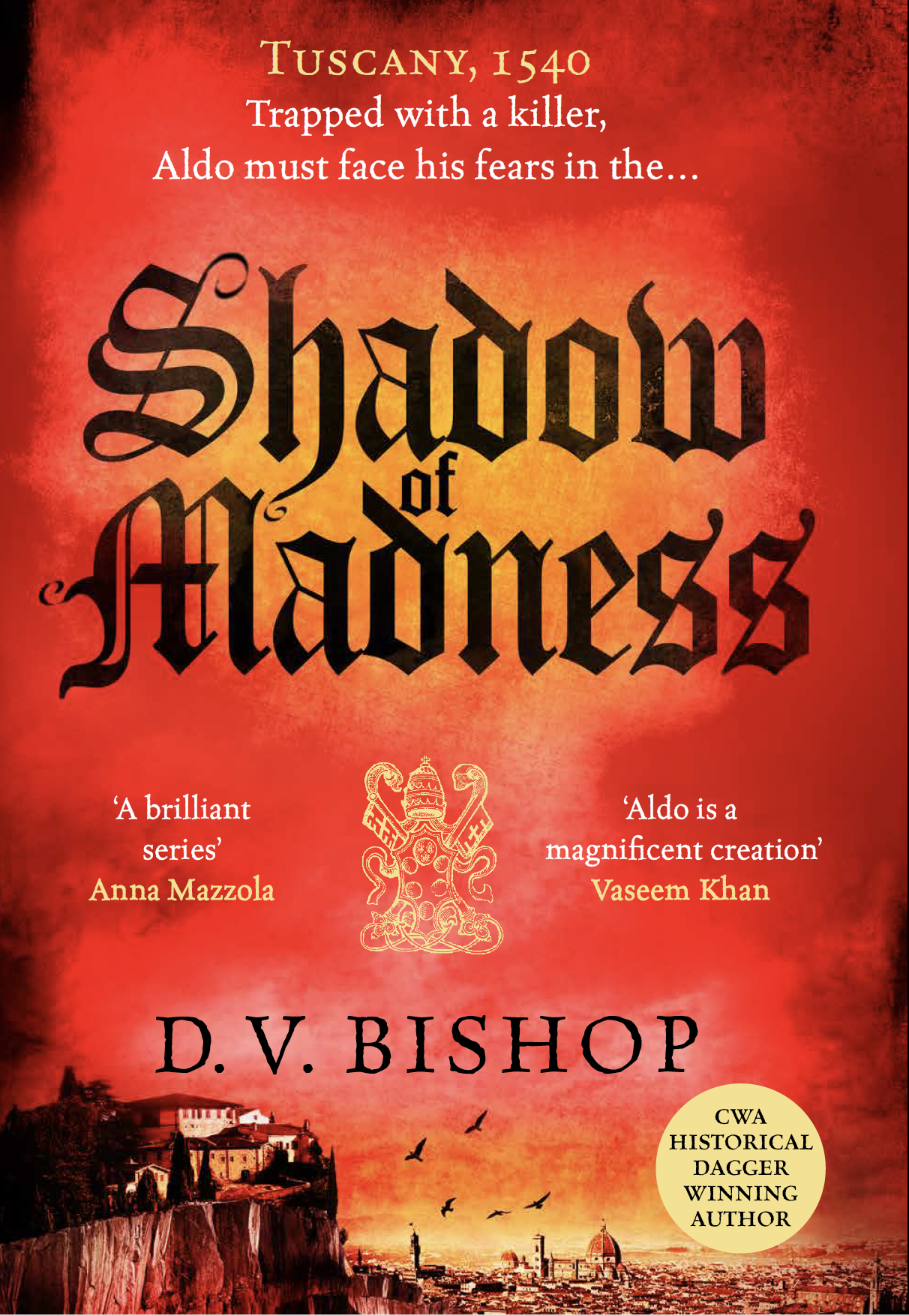
Travelling north into the hills above Florence, investigator Cesare Aldo seeks answers about his past. The trail leads him to Ospedale de' Pazzi, a secure institution for the criminally insane.

Soon after arriving a blizzard engulfs the area, trapping Aldo and his companion, Doctor Saul Orvieto. Even more alarming, their cart driver is found dead. It looks like he fell over a nearby cliff in the whiteout – but Aldo suspects foul play.

When a brutal slaying occurs in the central courtyard, it becomes clear a killer lurks among them. With the snowstorm sealing everyone in and a murderer hunting fresh victims, Aldo’s search for the truth proves deadlier than he could ever have imagined . . .

Extract from Shadow of Madness

Thursday, December 29th 1540

Cesare Aldo stared at the man opposite as the cart bumped and jolted up the rough dirt track. Saul Orvieto was his friend, his lover, and a good doctor to the Jews of Florence. When Aldo had still been investigating crimes for the Otto, the city’s most powerful criminal court, Saul helped solve some of those with his expertise in bodies. But that did not mean they were always in agreement, and this was a moment when Saul was simply wrong.

‘You don’t believe in evil?’

‘No,’ Saul replied.

‘But you’ve seen the things men do. Stabbings, rapes, even burning people alive, and all because of greed or hatred or lust. How can you not believe in evil?’

The doctor stroked his thick russet beard. Grey was appearing in Saul’s hair, and more wrinkles framed his warm hazel eyes, but that only made him more handsome. ‘I don’t deny men do evil things,’ he said. ‘Some more than others. But I’m not convinced this makes such men evil, or that they carry evil inside them.’

Aldo shook his head. ‘Then how do you explain their actions?’

‘No doubt each one had their reasons, and believed in those enough to do what they did. You said it yourself; violence is caused by greed, hatred and lust. Take those away and most men have no reason to kill, no cause to be cruel or inflict suffering.’

‘Most men? So, you agree some men are outside these boundaries of yours.’

Saul’s face saddened. ‘There are always those who cannot control their actions, whose judgement is damaged or their conscience overcome by madness. But that is an illness of the mind, not proof of evil. Such people are suffering in their own anguish, and deserve our pity. We will probably find men, and perhaps even some women, like that where we are going.’

Aldo and Saul were travelling north, high up into the Tuscan hills above Florence to visit Ospedale de’ Pazzi. Years ago, it was where wealthy famiglie sent their daughters to spend the last months of an illegitimate pregnancy. The babies were born far from prying eyes and gossiping neighbours, shielding the parents from shame. Most of the infants were given to the Church for adoption or passed on to an orphanage for foundlings.

Over time the building’s purpose had changed, becoming an institution where those who had lost their reason or were deemed incurabili could be locked away out of sight. Officially, it was called Ospedale de’ Pazzi, but a nickname from decades past – La Macchia – still lingered, because anyone sent there was seen as a stain on their famiglia. In recent years the ospedale had changed again, becoming a place where the worst, the most dangerous of Florence’s incurabili were sent – out of their minds, and out of sight.

Aldo had used a precious favour owed by Cosimo de’ Medici, the ruler of Florence, to secure a letter of authority signed by the duke in order to make an official visit to the ospedale. Because La Macchia was administered by the Church with both monks and nuns present he had also required permission from the diocese of Florence. That meant meeting Monsignor Testardo, a severe cleric Aldo had encountered more than once while serving the Otto. Testardo reluctantly gave the Church’s approval for this visit to the ospedale, but had demanded a full report on it as the price for that. By rights, such a report should be made by a senior diocesan official, but Testardo had no wish to visit La Macchia in the dead of winter.

If securing authority to inspect the ospedale had been difficult, obtaining the means of getting there proved even more so. If Aldo were travelling alone, he would have hired a horse and ridden up into the hills. But Saul insisted on coming too, and he was far less comfortable in a saddle. Walking would take time the good doctor could not spare from his patients. The solution was finding the cart driver who took supplies to La Macchia each week and paying him handsomely for a ride. But the driver refused to have anyone sit alongside him, so they were stuck in the back of his cart among the sacks and barrels bound for the ospedale.

To pass the time, Aldo was debating with Saul about morality. He agreed with much of what the doctor said and they shared a mutual respect, even when their beliefs diverged. It was one of the reasons he and Saul were close, despite the laws of God and man forbidding what they did together in bed. But Aldo had seen the worst of men during his youth on the streets of Florence, his time riding as a mercenary, and his many years enforcing laws for the Otto. ‘You cannot deny that a man such as Father Pagolo Zati was evil,’ he said.

Saul shivered. The wintry air was cold and getting colder as they went higher into the hills, but Aldo knew that was not the reason for Saul’s trembling. ‘I saw only what Zati did,’ the doctor replied. ‘Yes, his crimes were evil in nature, but they may have been the work of a disordered mind. You were the one who spoke with him.’

Aldo had questioned Zati after the priest admitted garrotting two men, bisecting their tongues lengthways, and writing holy words on their foreheads with ash. Zati had previously killed elderly parishioners in his care, though the crimes remained unproven. The priest himself had dismissed those as the work of a novice still learning his craft.

‘Zati told me he had always known he was different, better than those around him,’ Aldo recalled. ‘To become who you truly are, he said, you must trust your judgement above all else. Zati believed there was beauty to be found in murder, and a purity in what he—’

‘Enough.’ Saul held up a hand. ‘I will concede that there are some men whose acts are truly evil. Let us be thankful they are few and far between, and that Zati is dead.’

‘Do you two ever cease talking?’ the cart driver asked, glancing back at them while scratching at his thick black beard.

‘It keeps us occupied,’ Aldo replied. ‘How much further?’

‘You’ll see La Macchia round the next bend.’ The driver urged his horses on with a snap of the reins. ‘If you’re looking for evil, you are going to the right place.’

‘Why do you say that?’ Saul asked.

‘Only been inside once, but it was enough. Made me cold to my bones. The worst of the worst are kept there, but the guards and even the monks – they’re all mad, bad or worse.’

‘I was told there are nuns at the ospedale,’ Aldo said.

‘Four of them,’ the driver confirmed, ‘looking after the women inmates. Mostly the nuns stay in their part of the building, keep themselves to themselves. I don’t blame them. People from the village who come up the hill to work at La Macchia always leave before dusk. That place does something to a person, changes them. Stay there a night, you’ll see.’

‘Then it’s a good thing we are returning back down the hill with you today.’ Aldo gave Saul a reassuring smile. ‘We should only be inside a few hours, at most.’

‘Just make sure you’re ready to leave when I am.’ The driver jabbed a finger at the glowering sky. Heavy, grey-white clouds were gathering overhead. ‘That’s snow, and plenty of it. La Macchia has been cut off in the past when the weather closes in.’ The driver scratched his beard again. ‘One year was so bad, it took nine days for anyone to reach the ospedale. No wonder they all go strange, sooner or later.’

Next
Next

Carnival of Lies (2025)